
How it works
How Does a Walkie Talkie Work? (No Tower, No Internet)
How does a walkie talkie work with no tower or internet? Follow one word from your mouth to a speaker a mile away, plus range, squelch and privacy codes.

How does a walkie talkie work?
There’s no tower, no satellite and no internet between two walkie talkies, yet your voice crosses a mile of empty air in five millionths of a second. Let’s follow it.
Picture two radios, the kind sold in a blister pack at any outdoor store. One is in your hand at the edge of a campsite. The other is a mile away, clipped to a backpack on a hiking trail. Nothing connects them. No cable, no cell network, no monthly bill.
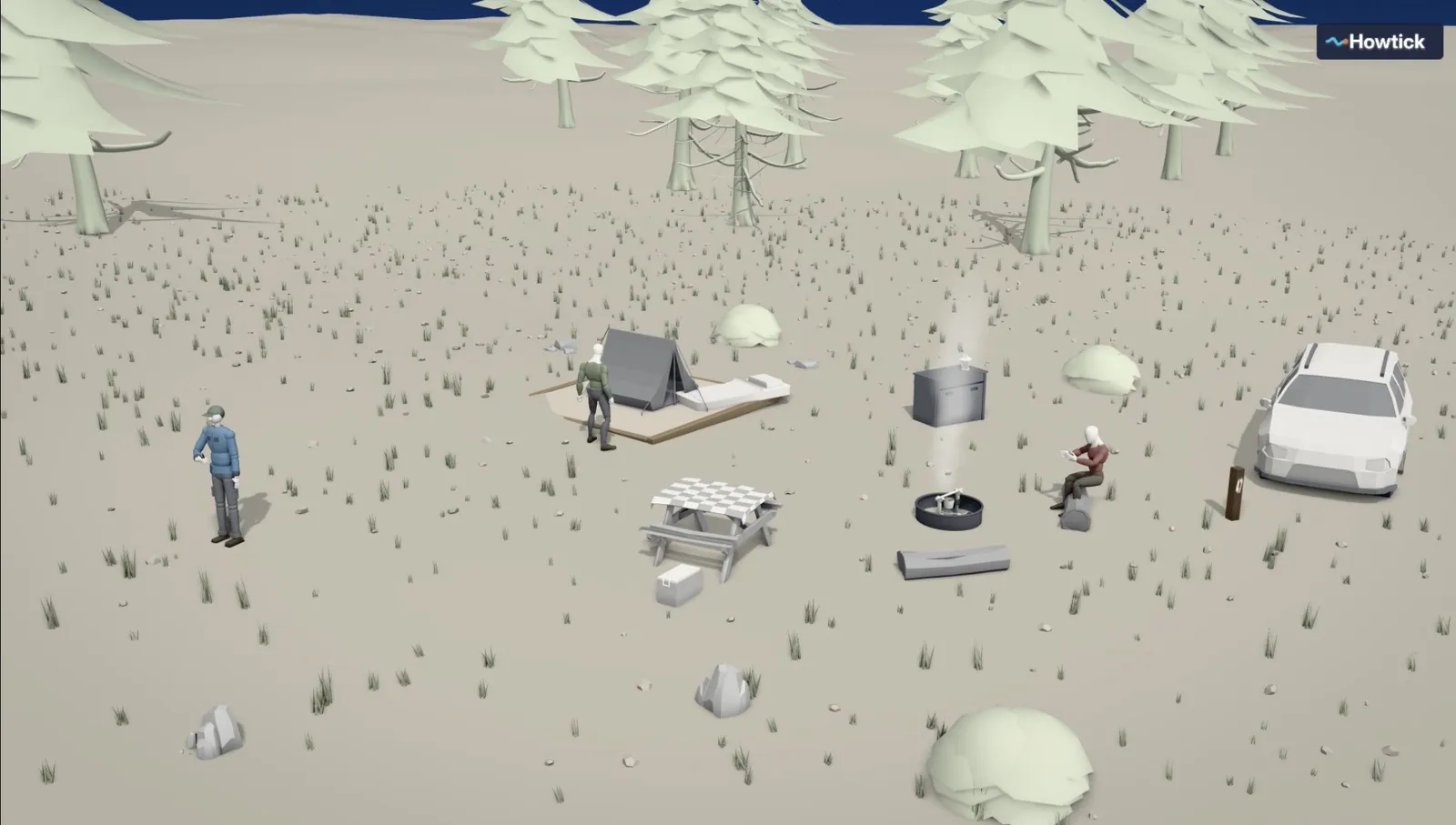
And here is the word we are going to follow. “Over.” It means: I have finished talking, now it’s your turn. It is about four tenths of a second long. It will be turned into electricity, pressed onto an invisible wave, thrown off an antenna, pulled out of the air a mile away and turned back into sound.
Along the way, it will answer the four questions almost every owner of these radios eventually asks. Why can only one person talk at a time? What is that hiss? Why are the “privacy codes” not private? And why does the box promise 35 miles when you only ever get two?
The short answer: a walkie talkie turns your voice into a changing voltage, uses that voltage to nudge the frequency of a 462 MHz radio wave (FM), and throws the wave straight through the air to a second radio on the same channel, which undoes each step and turns it back into sound. No network is involved, which is also why only one person can talk at a time and why hills and trees, not battery power, decide the range.
From your mouth to a wire
You press the big button on the side and say “Over.”
The word leaves your lips as a pressure wave, a train of tiny squeezes and stretches in the air. It moves at about 343 metres per second, the speed of sound. The microphone sits about five centimetres from your mouth, so the word needs roughly a seventh of a thousandth of a second just to reach it. Remember that number. It’s the slowest part of the whole trip.
Behind a little grille is a microphone smaller than a pea. Inside it, a thin diaphragm sits a hair’s breadth in front of a plate that carries a permanent electric charge. The two together form a tiny capacitor. When the squeezes of your voice push the diaphragm in, the gap shrinks. When the stretches pull it out, the gap grows. Every change in that gap changes the voltage across it.
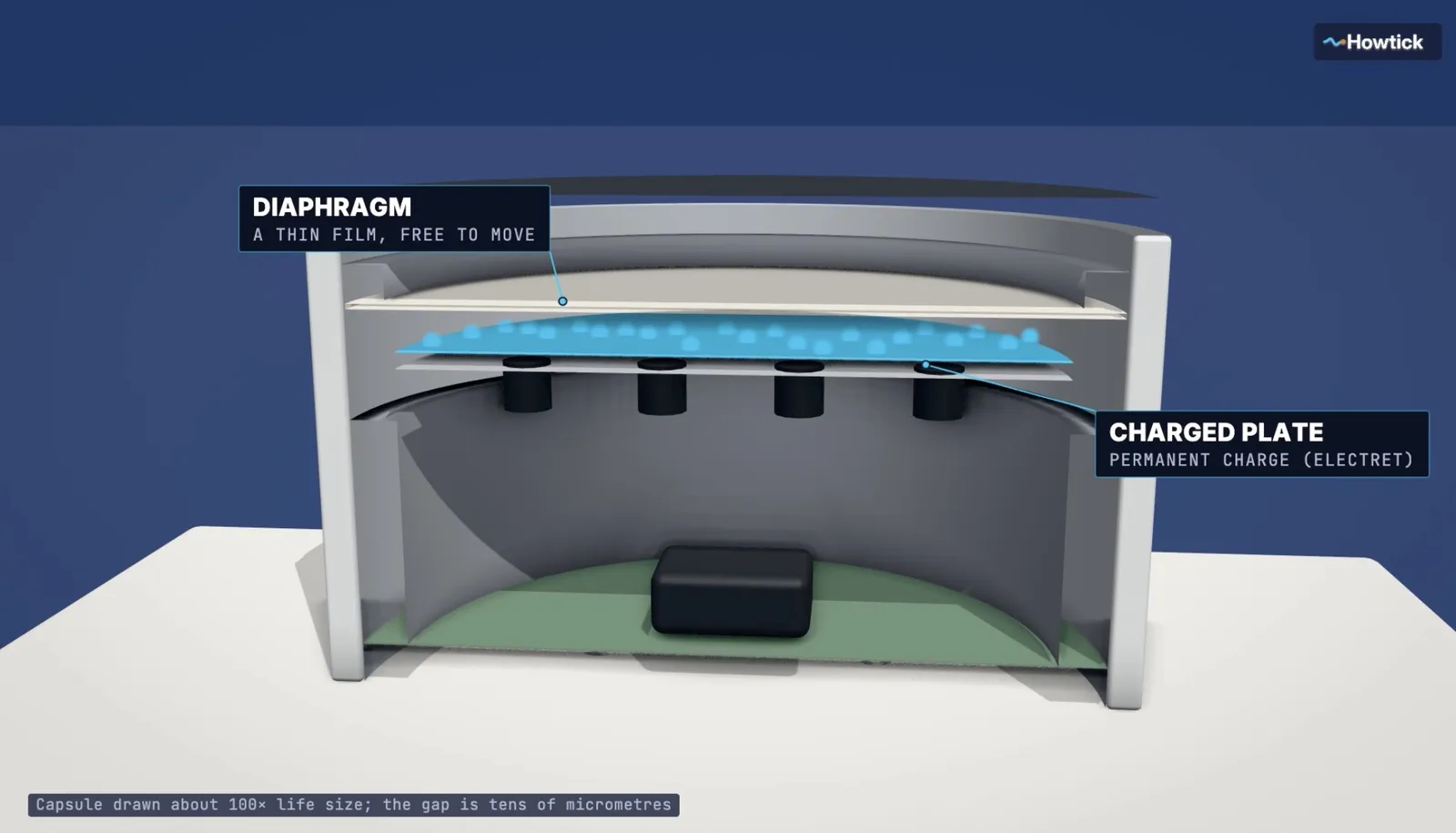
So now “Over” is no longer sound. It’s a voltage that rises and falls in exactly the same shape as the pressure wave did.
But that voltage wiggles only a few hundred to a few thousand times per second. To get it across a mile of air, the radio needs something much faster to carry it.
Riding a wave: how FM carries your voice
That carrier is made by a tiny oscillator inside the radio. On channel one of an American family radio, it vibrates 462.5625 million times every second. That is 462 megahertz (MHz).
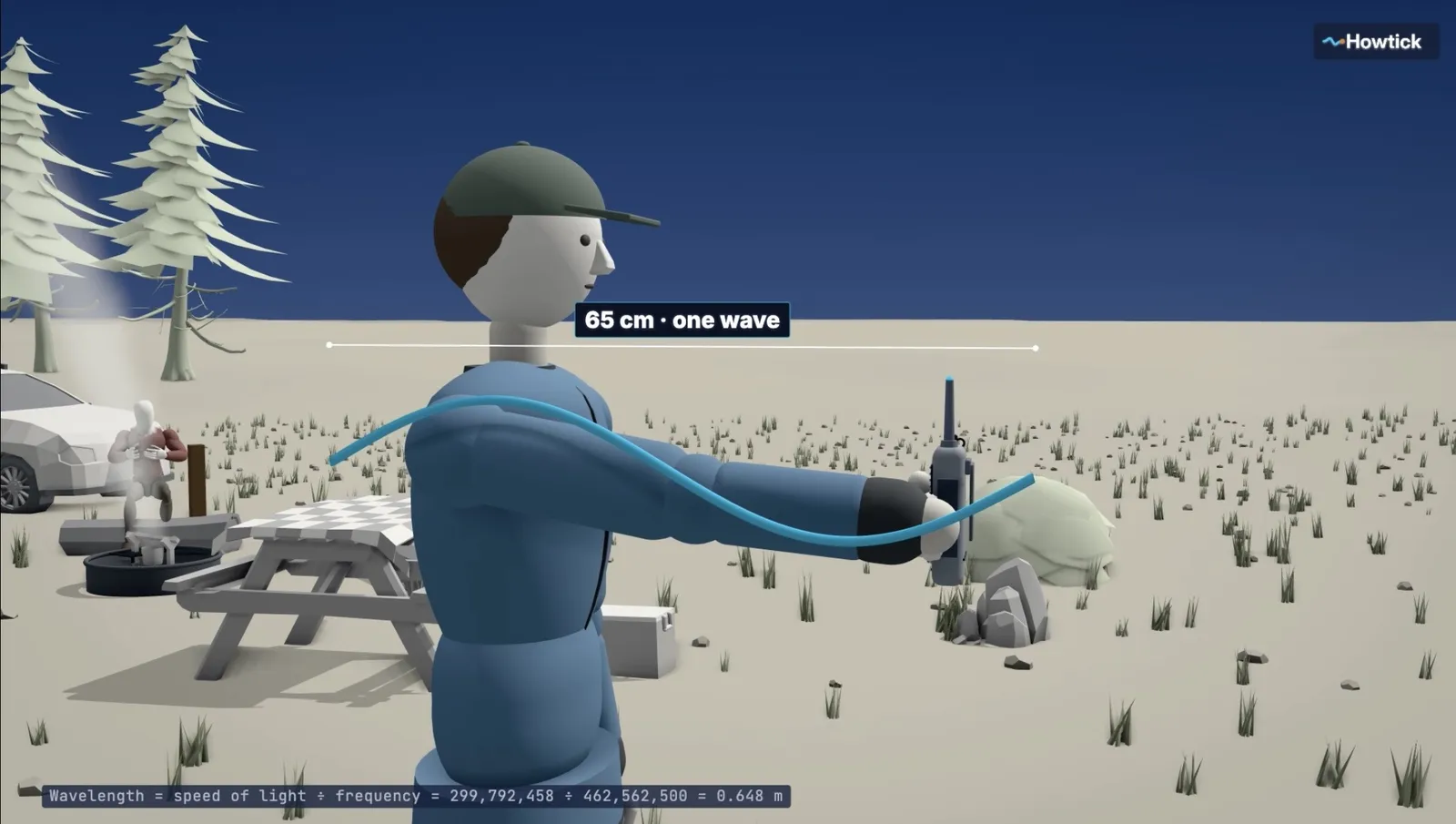
At that rate, each wave is about 65 centimetres long, roughly the length of your arm. During the four tenths of a second it takes to say “Over,” the carrier will swing back and forth about 185 million times.
On its own, the carrier says nothing. The trick is to change it in a way the far radio can undo. These radios use frequency modulation, FM. As your voice voltage rises, the carrier speeds up a little. As it falls, the carrier slows down a little. The loudness of your voice sets how far it shifts. The pitch of your voice sets how often.
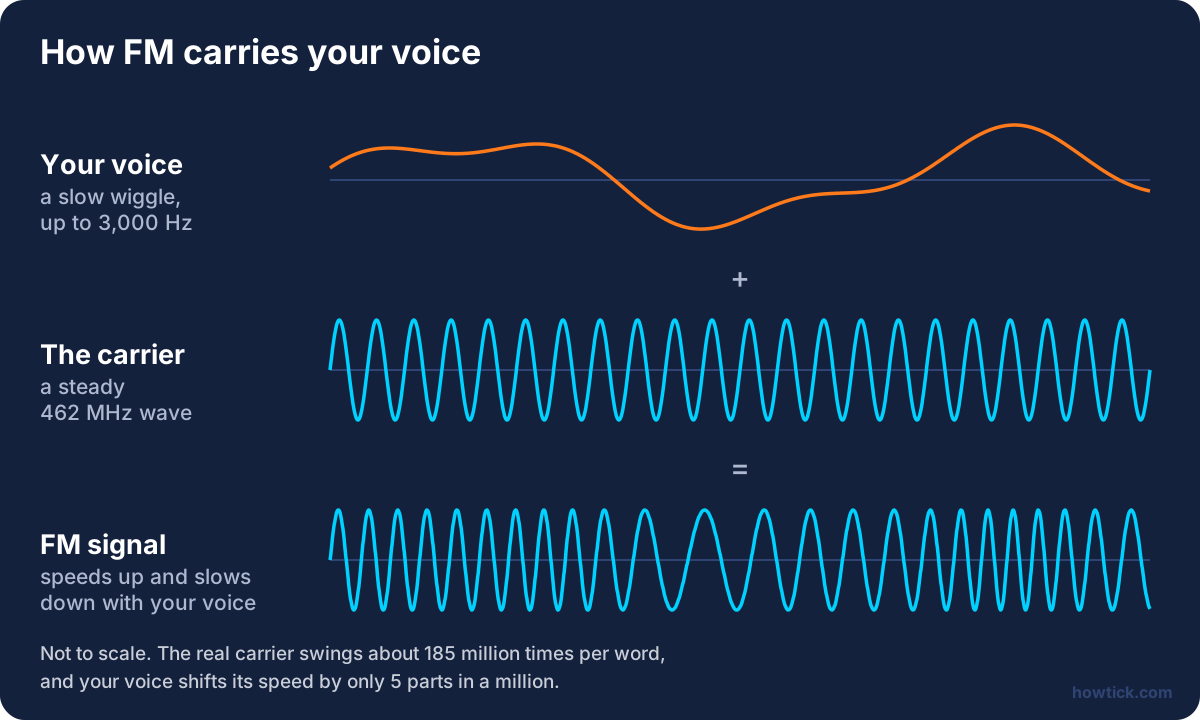
And “a little” really means a little. The rules for these radios allow the frequency to swing by at most 2.5 kHz either way. That’s about five parts in a million. If the carrier were a car driving at a hundred kilometres an hour, your voice would nudge its speed by half a metre per hour.
The rules also cut off any part of your voice above about 3,000 Hz. That’s why every walkie talkie sounds thin and boxy. The deep chest of your voice and the sparkle of the “s” are trimmed away, and only the middle band that carries the meaning survives.
Now “Over” is hidden in the timing of a wave. All that is left is to let it go.
Off the antenna
The signal is amplified to at most two watts, the legal limit on most family radio channels in the United States since 2017. Two watts is less power than a single household LED bulb uses.
It flows up into the stubby antenna, which by law must be fixed to the radio. Electrons rush up and down it 462 million times a second. Charges that accelerate like that shake the electric and magnetic fields around them, and that shaking peels away from the antenna and travels outward on its own. That is a radio wave. Light, in a colour our eyes can’t see.
It leaves in every direction at once, a vertical ring spreading out like a ripple on a pond. It moves at the speed of light, 300,000 kilometres per second.
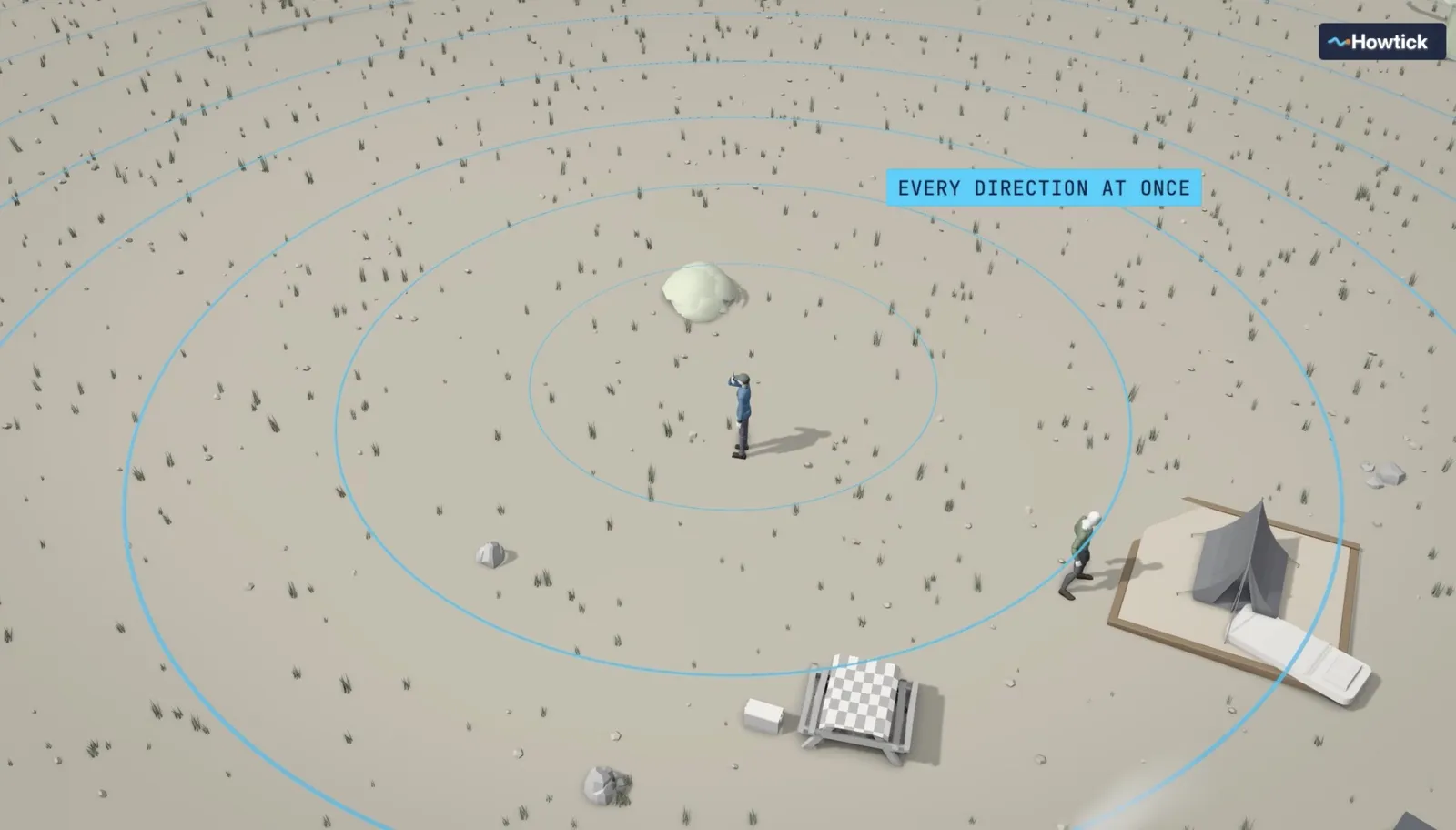
Here is the number from the start. A mile is about 1,609 metres. Light covers that in 5.4 millionths of a second. The trip from your lips to the microphone took about 27 times longer than the trip across the whole mile.
A mile away, the second radio’s antenna is hanging in the same ripple. The passing wave pushes its electrons up and down, ever so slightly. Out of the two watts that left your hand, what arrives is a few billionths of a watt. It’s enough.
Why only one person can talk
Now the first question. Why do you have to say “Over” at all? Why can’t you both just talk, like on a phone?
Because both radios are using the same frequency for both jobs. Your radio talks on 462.5625 MHz, and it listens on 462.5625 MHz. When you press the button, the same antenna is switched away from the receiver and onto the transmitter.
Even if it weren’t, it wouldn’t help. Your own two watts, a few centimetres away, would be about a billion times stronger than the faint whisper arriving from a mile off. It would be like trying to hear a friend calling from across a valley while shouting into your own ear. So while you transmit, your radio is deaf.
Your phone gets around this with separate frequencies for each direction and a tower in between. These radios are half duplex. One channel, one direction at a time.
And if two people press the button at once, a quirk of FM decides what happens. An FM receiver locks onto whichever signal is stronger and pushes the weaker one aside. It’s called the capture effect. A third person listening hears only the louder of the two. If the signals are nearly equal, they hear a garbled, fluttering mess. And the two people talking hear nothing at all, because both of them are deaf.
That’s why radio operators invented a little grammar. “Over” means I am done, your turn. “Out” means I am done, and the conversation is finished. Which is why a careful radio operator never says “over and out.” It asks for a reply and refuses one in the same breath.
The hiss: what squelch does
Back to our word. It’s arrived in the second radio as a faint wiggle on the antenna. The receiver amplifies it millions of times, then a circuit called a discriminator measures how the frequency is speeding up and slowing down. Out comes the same rising and falling voltage that left your microphone. A small amplifier drives the speaker, and the speaker’s cone pushes the air. “Over.”
But just before the word, and just after it, there is a sound everyone knows. A short burst of hiss. Where does that come from?
It comes from heat. Every electron in the receiver’s circuits, and in the warm ground and trees around it, jiggles randomly just because it is above absolute zero. Those jiggles make a faint, random electrical noise across every frequency. At room temperature, it’s tiny. But a receiver built to hear a few billionths of a watt is extremely sensitive. With no real signal to lock onto, the FM discriminator happily turns that random noise into a loud, steady rush.
When a real carrier arrives, it overwhelms the noise and the hiss drops away. With FM, a strong signal is not just louder, it’s cleaner.
To keep you from listening to that rush all day, the radio has a gate called squelch. It constantly measures the noise above the range of speech. While the noise is high, it keeps the speaker shut. When a carrier arrives and the noise falls, the gate opens.
So the hiss you hear at the end of every transmission is the gap between two moments. The other person lets go of the button, the carrier vanishes, the noise rushes back in, and for a fraction of a second, before the squelch notices and snaps shut, you hear the sound of heat itself.
Privacy codes that aren’t private
Now look at the box your radios came in. One popular pair advertises 121 privacy codes. Pick one, the box suggests, and your conversations are your own.
They’re not. Here’s what a privacy code actually does.
When you set a code, your radio adds a steady, very low tone to everything it sends, for example 67 Hz, a deep hum down near the bottom of a bass guitar. The receiving radio with the same code listens for that hum. Only when it hears it does it open the squelch. Then it filters the hum back out, so you never notice it.
There are 38 of these tones, from 67 Hz up to about 250 Hz. The other 83 codes on that box are a digital version of the same idea. Add 38 and 83 and you get 121.
Notice what changed. Nothing about the signal is hidden. Your “Over” is still riding the same carrier, on the same channel, in plain FM. The code doesn’t lock your voice. It only decides which voices your own radio bothers to play.
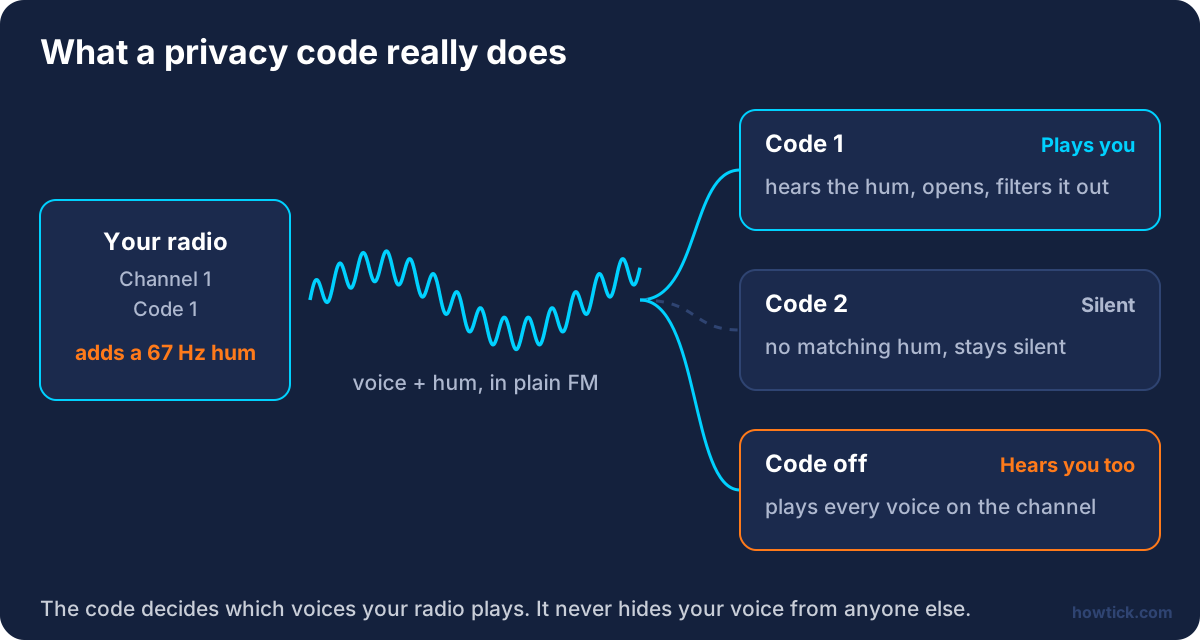
Anyone with a radio on the same channel and the code switched off hears everything you say, plus everything everyone else says. Even Motorola’s old name for this system, Private Line, was about keeping other people’s chatter out of your speaker, not keeping your words away from anyone else.
So a privacy code is not a lock on your door. It’s earplugs for your radio. There are still only 22 channels, and every one of them can be heard.
Why you never get 35 miles
Finally, the biggest letdown of all. The packaging says 35 miles. In the real world, a mile or two is a good day.
Strangely, the problem is not power. Remember: two watts left your hand, and the receiver can pick up a signal about a million billion times weaker than that. As a wave spreads out, it thins. Every time the distance doubles, the power reaching a receiver drops to a quarter. But with that much headroom, in completely empty space, two little radios could hear each other from about 2,000 kilometres apart.
The problem is the Earth.
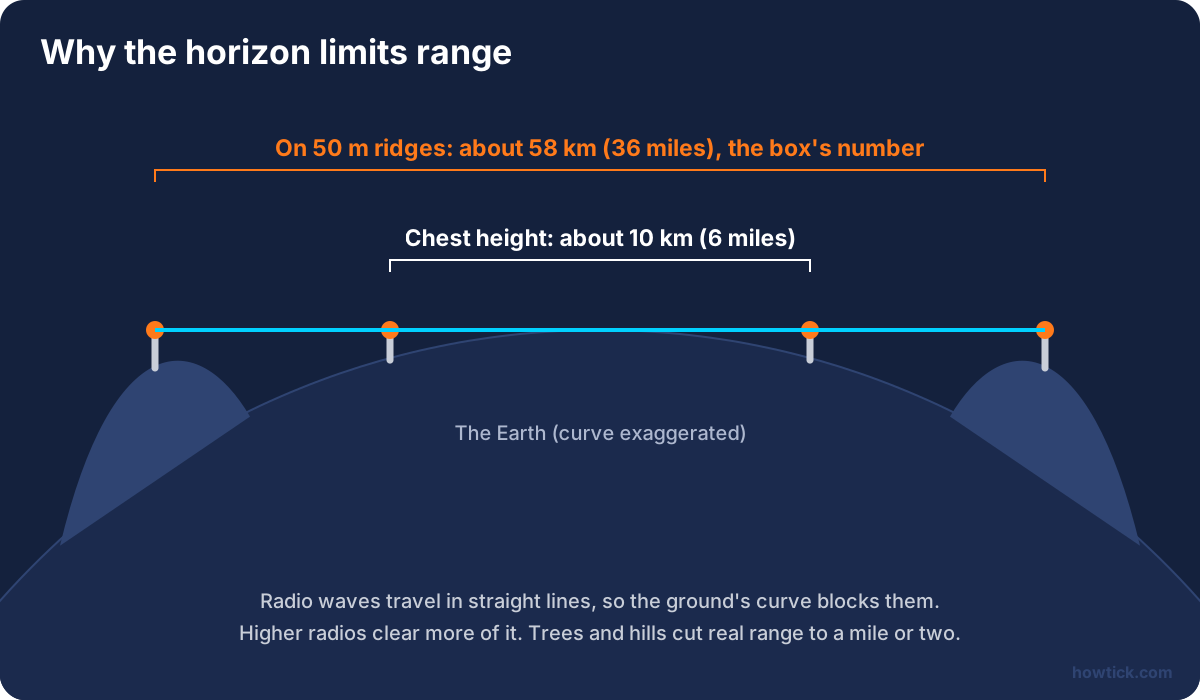
These radio waves travel in nearly straight lines. They bend slightly around the curve of the planet, but not much. So the real limit is the horizon. Hold the radio at chest height, about 1.5 metres off the ground, and the radio horizon between two people on perfectly flat ground is about 10 kilometres, or six miles. That is the best you can ever do standing on a beach.
Now put both people on top of ridges, each about 50 metres above the land in between. The horizon moves out to almost 60 kilometres, about 36 miles. That’s where numbers like the one on the box come from. The fine print says it plainly: range is measured with an unobstructed line of sight, in optimum conditions.
Then there’s the space around the line. A radio wave isn’t a thin laser. Between two radios a mile apart, the signal travels through a fat, invisible football of space about 16 metres across at its widest. Your radio is held 1.5 metres up. Most of that football is buried in the ground, and the ground soaks up energy.
And then there’s everything on the ground. Trees are full of water, and water absorbs radio waves at these frequencies. So do people. Hills block them completely. Buildings of concrete and steel reflect and swallow them. One manufacturer’s own fine print says that in a city the effective range is usually less than half a mile.
So the box isn’t exactly lying. It’s describing two mountaintops on a clear day. You’re standing in a forest.
If you want more range, don’t buy a bigger number. Climb the hill. Stand in the open. Hold the radio up, antenna pointing straight at the sky, the way it was designed to send.
Out of the other speaker
Let’s put our word back together.
You pressed the button. “Over” left your mouth as a pressure wave and took a seventh of a thousandth of a second to cross five centimetres. A charged diaphragm turned it into a voltage. That voltage nudged a 462 MHz carrier by a few parts in a million. Two watts pushed electrons up and down a stubby antenna, and the wave left at the speed of light, crossing a mile in five millionths of a second, through leaves and fabric and sleeves.
A mile away, a few billionths of a watt shook another antenna. The receiver amplified it, read the tiny shifts in frequency, heard the right sub-audible hum, and opened its gate. The noise of heat fell silent, and a paper cone pushed the air.
“Over.”
No tower. No satellite. No internet. Just two small boxes, one shared frequency, and a straight line through empty air. Now it’s your turn.